China's tariff account clouds Trump summit trade claims
Beijing's account of the Trump-Xi summit suggests tariffs were discussed and perhaps partially bargained, raising questions about what trade terms were actually settled.
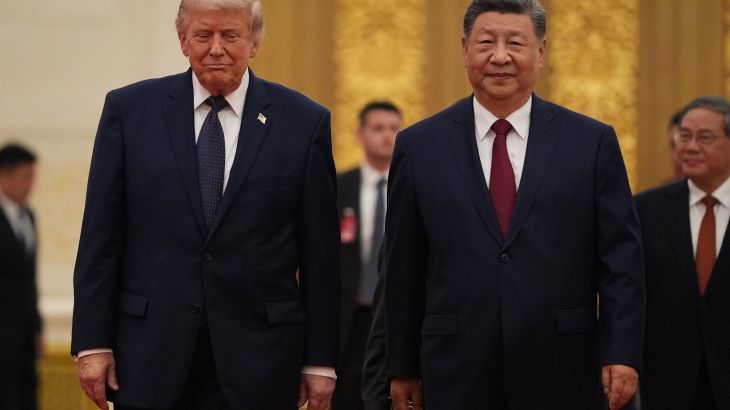
China has published its account of Donald Trump’s summit with Xi Jinping, and it reopens the sharpest question left hanging after the Beijing meeting: did the leaders produce a real trade deal or just a diplomatic pause?
Trump said tariffs were not discussed. Hours later China’s commerce ministry announced a new trade council would negotiate reductions on specific products. What began as a dispute over public messaging has become a test of what the summit actually settled on trade.
Tariffs were supposed to be the hard edge of the US-China relationship. If Beijing is right, the summit did more than steady the tone between the two capitals — it created a preliminary mechanism for bargaining over market access, product by product, while the broader tariff wall stayed in place. If Trump’s version is closer to the truth, China is presenting aspirations as agreements, talking implementation before the two sides have fixed the terms.
Beijing’s account is detailed, and that makes the gap hard to dismiss. Trump’s line was blunt: “We didn’t discuss tariffs.” The Chinese commerce ministry offered a narrower, more operational version — the new forum would handle tariff reductions on specific products, while separate trade and investment bodies kept talks going after the summit. The South China Morning Post reported the architecture as a pair of councils, not an open-ended promise to talk later.
The two accounts diverge enough to carry consequences. A managed process, even a narrow one, gives exporters, importers and supply-chain planners something to price. A handshake without a mechanism does not. Both governments appear to have wanted the symbolism of stability. At least one side also wanted a channel for slicing away at selected trade barriers without reopening the full trade war.
Where the substance lies
The most revealing detail in the early reporting was the $30 billion of goods reportedly inside the initial tariff-cut basket. Small relative to bilateral trade, but large enough to matter if the product list includes politically sensitive sectors. Reuters also reported discussion of a 10 percentage-point reduction in US tariffs on Chinese goods — a cut that would still leave the average effective US rate at 47 per cent on most Chinese imports. Even the more concessionary reading of the summit points to calibration, not normalisation.
Product-by-product talks let both governments test constituencies, reward politically important sectors and protect areas each treats as strategic. Left unsettled after the summit is what sits inside the first tranche. A list heavy on consumer goods delivers a modest but visible economic effect. A list reaching into industrial inputs sends a larger signal to manufacturers and investors.
Side deals matter almost as much as the tariff language. Trump said China would buy 200 Boeing jets, and other reporting pointed to easier access for some US farm goods. Those are commitments that fit a managed-trade framework: visible, countable, politically saleable at home. They also stop far short of a broad settlement over industrial policy, export controls, subsidies or advanced technology, the disputes that have defined the tougher phase of US-China economic rivalry.
The narrow basket also explains why both sides could claim success without describing the same agreement. Washington can say the summit delivered commercial wins without advertising a softer tariff stance. Beijing can say tariff relief is now inside a formal channel without claiming the wider tariff regime will disappear. Both narratives coexist because the public still has not seen the product lists, the sequencing or the enforcement terms.
Why Beijing spoke first
Beijing had a clear reason to be more explicit. A summit remembered for optics alone becomes, in China’s telling, the start of a practical economic process. That framing tells domestic businesses they may have a route to lower costs and tells foreign investors the relationship is not drifting into uncontrolled escalation. It also puts pressure on the White House. Once China says tariff reductions are part of the machinery, Washington’s silence starts to read as ambiguity, not discipline.
Leaving aside the leverage question misses part of the story. Beijing sought predictability more than spectacle. Trump needed a visit he could sell as commercially productive without conceding the tariff wall needs wholesale dismantling. A limited tariff mechanism serves both: China gets a path to argue pressure is easing; Trump gets room to sell concessions as selective wins extracted from Xi rather than a retreat from his own policy.
Reuters, quoting China analyst Craig Singleton, said the meeting “projected stability but it left the stalemate intact.” Stability was real. Trump and Xi reduced the immediate risk of a rupture and created space for officials to keep talking. Stalemate remains the baseline because the hard questions were deferred: which goods qualify, how fast duties fall, whether the cuts are reciprocal and what happens if either side decides the other is backsliding.
Markets will not care about diplomatic choreography if the paperwork never arrives. What they will watch is whether any published list matches the sectors most exposed to tariffs — industrial components, agriculture, aerospace. The mention of Boeing and farm goods points to the old logic of US-China bargaining: politically legible purchases stabilise relations faster than broader structural reforms. That logic buys time. It rarely settles the underlying dispute.
Tariff bargaining no longer sits on its own. Any effort to separate non-sensitive consumer goods from strategic sectors collides with the wider argument over economic security. A trade council handles product lists. It cannot resolve how Washington treats dual-use technology, how Beijing responds to investment restrictions or where either side draws the line between commerce and national power. The more specific the councils become, the faster those boundaries come into view.
The summit may have produced a preliminary trade channel but not yet a settled trade agreement. BBC reporting that the talks ended with few deals publicly confirmed matters as much as Beijing’s more detailed description. The scrutiny shifts from summit theatre to paperwork: the goods inside the basket, the timetable for reductions, the conditions on each concession. Until those details emerge, the summit looks like a controlled experiment in whether the two governments can trade narrower commercial relief for a broader political pause.

Ramona Castellanos
US politics correspondent covering Congress, primaries and the Trump administration. Reports from Washington.