Britain turns Typhoons into low-cost drone interceptors in Middle East
The RAF's decision to arm Typhoons with APKWS in the Middle East shows how cheaper drone interceptors are becoming central to air defence.
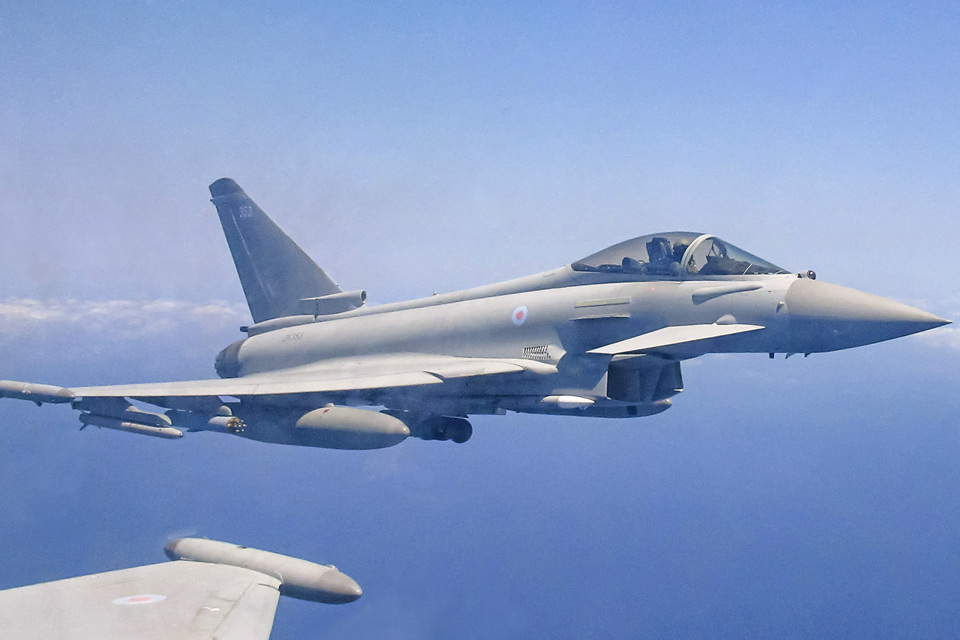
RAF Typhoons now flying in the Middle East carry Advanced Precision Kill Weapon System rockets — a laser-guided 70 mm munition adapted to hunt drones. Britain confirmed the loadout this week. It is not a trial. Western air forces are rewriting the cost arithmetic of air defence, and this deployment is the latest piece of evidence.
Janes broke the story that RAF Typhoons in theatre are flying with the rocket. The UK government followed up, confirming the weapon went from testing to operational use in less than two months. Low-cost interceptors were once treated as stopgaps. London is now fielding them as a front-line answer to the one-way attack drones that have been straining Western missile inventories across the region.
QinetiQ, the defence contractor that handled integration, said it had “rapidly fitted and tested laser guided, low-cost missiles to RAF Typhoons, which are now being used in the Middle East to defend against drone attacks”. The phrasing is not accidental. It frames the capability as a combat deployment, not a trial programme. Drones that cost a few thousand dollars to build, appear in salvos and are too expendable to justify a six-figure missile shot are forcing commanders to recalculate what a sensible intercept looks like.
The cost argument is now being made openly by British officials. Armed forces minister Luke Pollard said the system would help the RAF “shoot down many more drones at a much lower cost”. Air Commodore Donal McGurk, the senior RAF officer in theatre, called the rockets “a valuable addition” to the air defence package the RAF is already running across the Middle East. Price has become an explicit part of the operational case.
The arithmetic does the talking. An APKWS guidance section costs about $15,000 to $20,000, The War Zone reported. An AIM-9X Block II runs about $420,000. An AIM-120 AMRAAM exceeds $1 million. Range, seeker performance and mission sets differ — the comparison is not exact. Even so, when the target is a cheap drone, those numbers capture the bind commanders are in: using a premium air-to-air missile every time inverts the defender’s cost curve.
Across the Red Sea and the Gulf, allied forces have spent months confronting the same calculus. Cheap aerial threats appear in repeated waves and force hard choices about which weapons to expend first. Britain putting APKWS on Typhoons suggests the question has shifted. It is no longer whether cheaper interceptors are useful but where commanders can push them into front-line service without compromising the wider air mission.
Why the RAF moved fast
The timeline tells its own story. British aircrew have flown 2,500 hours since the regional conflict began, the government said, and it described the APKWS fielding as an urgent force-protection measure. Programmes that move from test to combat in weeks usually do so for one reason: crews need another option now.
Drone warfare has also erased the old boundary between high-end fighter operations and base defence. Typhoons are not being reduced to point-defence assets. They are getting an extra tool for a mission set that has migrated upward through the force — from ground-based systems and helicopters to fast jets that can patrol wider areas and react faster when the air picture grows crowded.
Aerospace Global News described the Typhoon loadout as part of the RAF’s answer to persistent drone attacks in the region. UK Defence Journal reported the weapon had moved from trial to deployed use. The emerging picture, across the official statements and the trade reporting, is that the RAF is pushing a cheaper shot into routine operations.
A fast jet also changes the geometry of a counter-drone mission. A Typhoon can reach a threatened area faster than a static defence and can fold the intercept mission into a broader air posture that already includes patrols, escort and regional deterrence. Air forces want flexible layers, not a single gold-plated missile for every class of threat.
The cost equation
The implications run beyond Britain. Western air forces have long preferred to discuss missile quality, radar reach and integration with allied networks, and those advantages still count against aircraft and cruise missiles. Lower-end air threats have reopened a cruder question: how many affordable shots can a force sustain night after night? Magazine depth and replenishment rate matter almost as much as raw missile performance in that calculation.
APKWS fits the logic because it is a mature system. Air & Space Forces Magazine describes it as a guidance kit that turns 70 mm rockets into precision weapons. Militaries see it as a quicker adaptation path than designing a new interceptor from scratch. The draw is speed, cost and availability.
A laser-guided rocket does not solve every counter-drone problem. Engagement conditions, target behaviour and cueing may not favour every shot. The Typhoon will still carry longer-range missiles for threats that are faster, farther away or more complex than the kind of drone raid a cheaper interceptor was designed to handle. APKWS is better understood as a way to preserve scarce top-tier missiles for the targets that genuinely require them.
Britain is accepting a new hierarchy of air threats. The expensive missile stays in the loadout but stops being the default answer to every object in the sky. That distinction is becoming central to air defence from the Gulf to Europe. Commanders are being asked to monitor more vectors, protect more infrastructure and do it without exhausting inventories built for a different era.
The RAF’s Typhoon deployment is a small episode in a larger shift. It is still a useful signal. When a frontline fighter starts carrying a low-cost rocket to hunt drones over the Middle East, cheap interceptors have moved beyond niche experimentation and into the practical core of how Western militaries expect to stay in the fight.

Theo Larkin
Defense correspondent covering US military operations, weapons procurement and the Pentagon. Reports from Washington.