White House prayer rally intensifies church-state fight in Washington
Trump and senior officials used a White House-backed prayer rally on the National Mall to invoke America's Christian roots, drawing renewed church-state criticism.
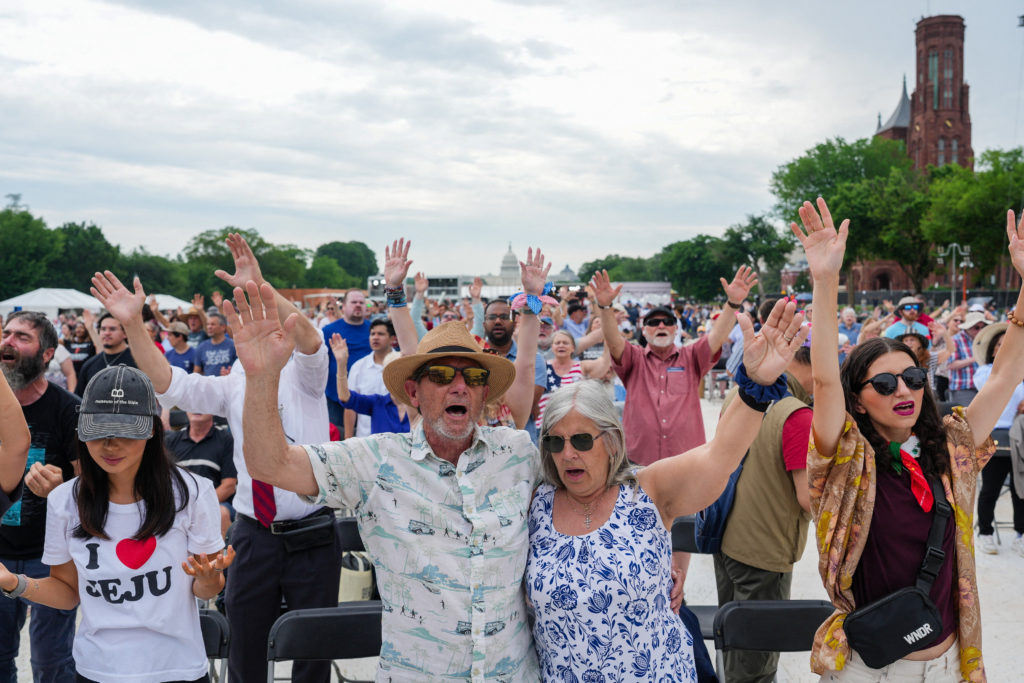
President Donald Trump and senior officials used a White House-backed prayer rally on the National Mall on Sunday to argue that the United States was founded on Christian principles, handing critics a fresh example of what they call the administration’s push to elevate one religious tradition through state power. Defense Secretary Pete Hegseth and Secretary of State Marco Rubio appeared alongside Trump at the Washington event, which combined public ceremony, patriotic symbolism and overtly religious language under the umbrella of a government anniversary programme.
The rally was part of the country’s 250th-anniversary observances, a detail that gave the gathering more weight than a routine faith event. Congress allocated $150 million toward the anniversary celebrations, according to CNN, and the White House used that national project to present the service as a statement about the country’s identity, not just its history. The institutional setting, more than the prayer itself, turned the event into a same-day political fight over church-state boundaries.
Organizers billed the rally as a chance to revive the idea of a country founded on Christian principles, according to the feed report that first surfaced the story. That pitch drew enthusiastic support from conservative Christians and immediate alarm from secular critics. The dispute was not over whether Americans could pray in public. It was over whether the White House should convert an official anniversary project into a platform for a distinctly Christian reading of the nation’s past.
The remarks from Trump’s allies sat at the center of the fight. Hegseth said “America was founded as a Christian nation”, a line that echoed a long-running conservative argument that the country has drifted from its religious roots. House Speaker Mike Johnson, speaking at the gathering, said Americans’ rights come from “our Creator and heavenly Father”, casting the rally as both a civic ceremony and a declaration about the source of political authority. Rubio was among the senior officials who appeared, giving the event the administration’s full weight.
The event’s lineup deepened the criticism. NPR reported that 18 out of 19 faith leaders were Christian, making it hard to argue the service was a broad interfaith moment. PBS, which described crowds packing into Washington’s National Mall for the rally, reported a heavily patriotic atmosphere at the gathering that showed how tightly the event bound national ritual to Christian language.
Critics’ warning
Annie Laurie Gaylor told Reuters that the rally amounted to “a fusion not only of church and state, but also of our federal government with Christian nationalism”. Her objection focused on the White House sponsorship, federal prestige and a national anniversary programme being used to promote one vision of American identity, rather than on private religious speech. The composition of the event, she and other critics argued, proved the point: the administration was using a federally supported anniversary framework to elevate Christianity in a civic space.
That argument has surfaced before during Trump’s political rise, but Sunday’s rally gave it a more formal stage. The event was a White House-backed gathering on the National Mall, promoted inside a federally supported semiquincentennial framework — not a campaign stop and not a gathering run at arm’s length from the state. For supporters, that meant a public reclaiming of faith language. For opponents, it meant government neutrality toward religion is being tested against the country’s most visible civic backdrop. The National Mall is the federal stage for inaugurations, mass protests and national commemorations, and Sunday’s rally put Christian language in that space with the White House’s blessing. That did not settle the constitutional question, but it made the political message harder to ignore.
Officials connected the rally to a broader argument about who defines the nation’s founding story by threading faith language through the 250th-anniversary agenda. Hegseth’s appeal to a Christian founding and Johnson’s description of rights as God-given were not throwaway lines. Together they set out a vision of the American project that critics say leaves little room for citizens who do not share it. The framing made the dispute harder to write off as a passing spat.
The political value of the event for Trump is straightforward. It speaks to conservative Christian voters who remain central to his coalition and gives allies a prominent stage to present religion as a core part of public life. The institutional consequences may outlast the day’s speeches. As the anniversary programme continues, each federally backed display of religious symbolism is likely to draw closer scrutiny from critics who see Sunday’s rally as a template rather than an isolated event.

Ramona Castellanos
US politics correspondent covering Congress, primaries and the Trump administration. Reports from Washington.