Kazakhstan rail gains as Iran war reroutes EU-China trade
Kazakhstan rail traffic is rising as the Iran war pushes China-Europe shippers toward the Middle Corridor and deeper spending on new capacity.
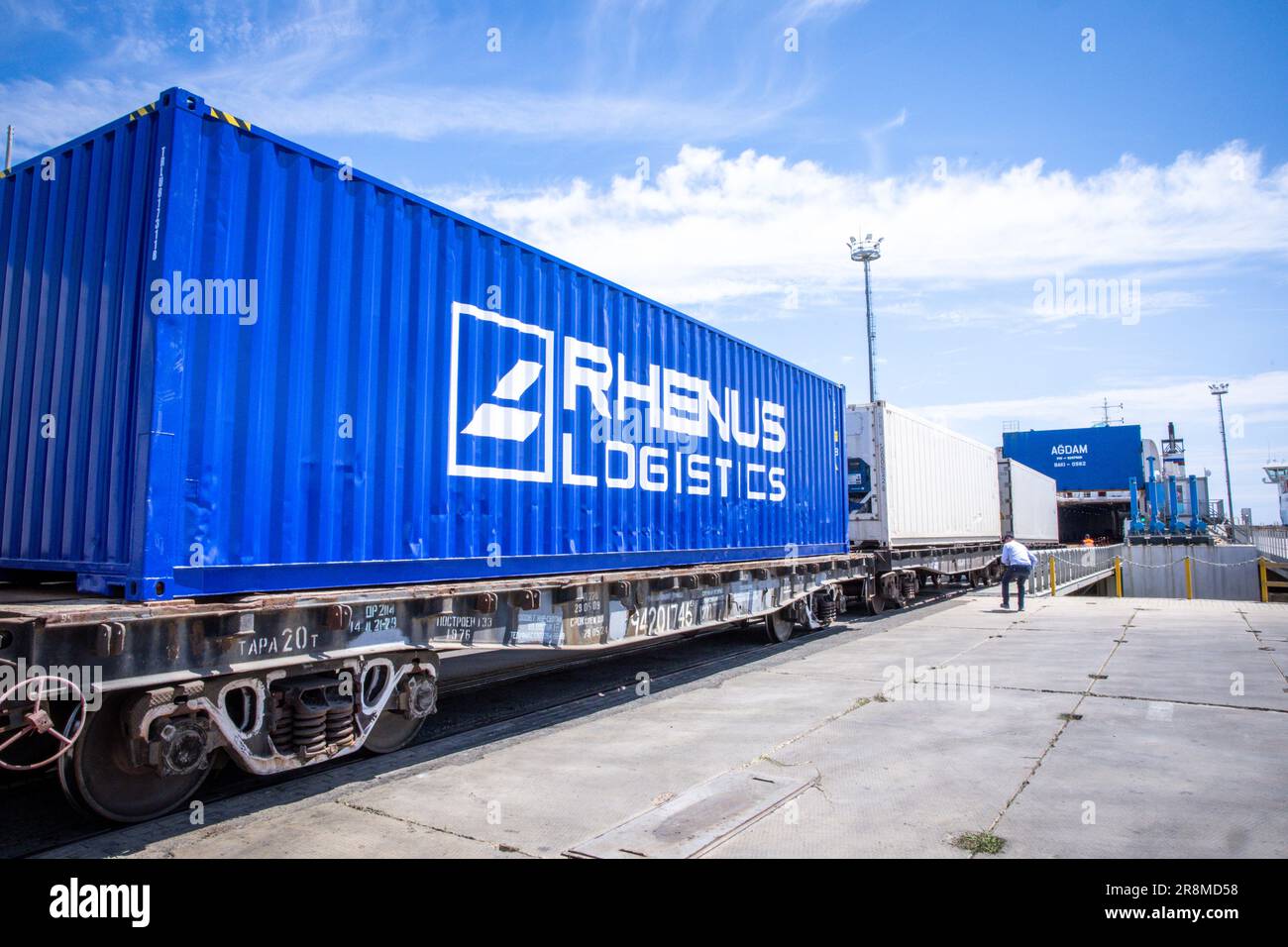
Kazakhstan is accelerating a $10 billion rail and logistics build-out because the Iran war has changed the risk calculus for moving goods between China and Europe, with Kazakhstan Temir Zholy saying shippers now value land routes for reliability as much as cost.
The immediate question for freight planners is whether a wartime diversion becomes a lasting shift. Sea lanes can reopen faster than railways can be laid, but once exporters, insurers and governments start paying for redundancy, a contingency route can become part of the base network. That is why a conflict centred on the Gulf is now reshaping infrastructure bets thousands of miles to the north.
But analysts who follow the Middle Corridor do not read the surge as a simple victory story. Cargo on the route reached 4.1 million tons in the first 11 months of 2024, up 63 per cent year on year, yet the Carnegie Endowment for International Peace has argued the corridor is still constrained by Caspian shipping capacity, border procedures and uneven political coordination. The route is becoming more valuable because the alternatives look brittle, not because this one is friction-free.
Talgat Aldybergenov, chief executive of KTZ, put the commercial logic plainly in Bloomberg’s report:
“Chinese clients have become more interested in shipping by land rather than by sea because of reliability and predictable delivery times.”
— Talgat Aldybergenov, CEO of Kazakhstan Temir Zholy
That line matters because Kazakhstan is not responding with a token reroute. KTZ says it is building 900 kilometers of rail lines this year, adding six vessels on the Caspian, expanding a terminal near Almaty and aiming to lift rail capacity between China and Kazakhstan to 100 million tons by 2030 from roughly 55 million tons now. That looks less like overflow management and more like a bet that repeated shocks, from war to sanctions to insurance spikes, will keep an overland hedge valuable.
Timing matters here. The corridor had already been growing after Russia’s 2022 invasion of Ukraine narrowed the appeal of the northern route, but the Iran war has given it a fresh selling point: schedule certainty. For exporters trying to protect delivery windows into Europe, a route that is somewhat slower but more predictable can be more valuable than the cheapest option on paper.
For Chinese manufacturers and European buyers, that logic is practical rather than geopolitical. If a supplier can quote a delivery window that is less exposed to Gulf disruption, the extra rail cost can start to look like insurance rather than waste.
Why shippers are looking north
The strategic appeal of the route is easy to see. Russia’s northern rail corridor has been harder for many European shippers to use since the invasion of Ukraine, while the Suez route remains exposed whenever fighting in the Middle East raises the risk of delays, attacks or higher insurance costs. As the Guardian wrote in an analysis from Armenia, governments along the corridor increasingly present themselves as a bridge between east and west rather than a sideshow to bigger powers.
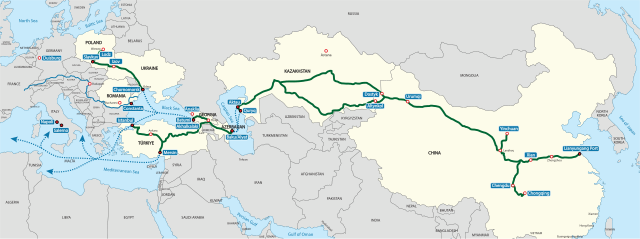
Geography alone does not close the case. The route still depends on multiple handoffs across rail, port and ferry networks, and the Caspian crossing remains a choke point. Even so, the corridor has gained something more durable than wartime traffic. It has gained political relevance in capitals that now see logistics resilience as part of economic security.
Elsewhere in the region, policymakers are reaching for the same conclusion from different directions. Semafor reported that projects such as the India-Middle East-Europe Economic Corridor and Iraq’s Development Road were drawing fresh attention as the Iran war forced governments to think harder about east-west connections. Kazakhstan’s route is not the same project, but it benefits from the same mood: Europe and Asia are paying more for optional corridors and less for elegant assumptions about a single safe artery.
That wider backdrop is visible in Europe’s own inflation debate. Reuters reported that the Iran war was already dragging on European growth while pushing prices higher, which helps explain why governments and companies are looking harder at alternative freight paths. In that reading, Kazakhstan is benefiting not just from a shipping detour but from a broader repricing of risk across Eurasia.
In the same Reuters analysis, JP Morgan analysts described the macro squeeze in blunt terms:
“This is the weakest level since late 2023 and, at face value, signals that the economy has been stagnating in May.”
— JP Morgan analysts, in Reuters
If growth is softening even before the full freight adjustment is absorbed, then the incentive to build routes that shave uncertainty out of supply chains becomes stronger. A corridor that cannot beat the sea route on price every day can still win business if it offers exporters a second lane when the first one looks politically unsafe.
A hedge, not a cure
The skeptic’s case is that the geopolitics may be outrunning the engineering. Carnegie’s assessment of the much-touted corridor is that customs frictions, limited port throughput and fragmented governance still stop it from scaling like a true mainline between Europe and China. That is a serious warning. Routes do not become bankable because officials describe them as strategic. They become bankable when a shipper can predict transit time, paperwork and cost from one end to the other.
From a regulator’s perspective, that means the steel is only half the story. Border rules, digital customs systems, berth scheduling on the Caspian and financing terms across several jurisdictions have to improve at the same time, or the corridor remains a political slogan with expensive hardware attached. That is the policy question running underneath the current rush of optimism: can a fragmented chain of states make itself reliable enough for long-term contracts?
Kazakhstan’s spending push suggests officials believe the answer can be yes, or at least yes often enough to justify the cost. A state company does not commit $10 billion, new rolling stock and new terminal capacity if it believes traffic will vanish with the next ceasefire headline. The Wabtec locomotive deal reported by Reuters points in the same direction: the corridor needs engines, not just speeches.
Markets, however, also show how quickly the pressure can ease. The Financial Times reported that oil prices fell on hopes of a Strait of Hormuz reopening, a reminder that some of the war premium in transport can disappear fast when traders start betting on de-escalation. That is why the strongest case for Kazakhstan is not that every diverted container will stay on rail. It is that every new crisis makes redundancy easier to finance and easier to defend politically.
The most likely answer to the durability question is therefore mixed. Some cargo will move back to sea if the Gulf stabilises and insurers cut premia. Yet a portion of today’s emergency traffic is already hardening into tomorrow’s fixed network, because each shock gives Europe, China and the transit states another reason to pay for optionality.
For Kazakhstan, that optionality is turning into leverage of a more concrete kind: track, vessels, terminals and transit contracts. For Europe and China, it is a reminder that the Iran war is not only an energy story. It is also redrawing the map of which land routes matter, and which countries get paid when global trade decides it can no longer rely on a single corridor.

Marcus Holloway
Markets editor covering UK gilts, sterling and the Bank of England. Previously a fixed-income strategist in the City.