Chip tariffs loom as US weighs levies for domestic fabs
Chip tariffs remain under review as the Trump administration weighs levies to push semiconductor manufacturing and supply chains into the US.

Washington and the chip industry face the same timing problem: how to threaten tariffs without slowing the factory buildout the White House says it wants. The Trump administration is weighing duties on imported semiconductors to pull more manufacturing into the United States, but US Trade Representative Jamieson Greer told Reuters that “there was not an immediate tariff coming,” leaving companies to plan around a warning rather than a levy.
For now, this is a supply-chain story before it becomes a customs story. The US still fully manufactures only about 10 per cent of the world’s chips, Reuters reported, and the administration is trying to shift more fabrication, packaging and testing home while new plants are still being financed and fitted out. Reuters tied Greer’s remarks to Micron’s planned US$200 billion investment in the United States and to the subsidy-heavy buildout that preceded Trump’s return, turning the tariff review into a test of industrial policy.
Analysts read the pause less charitably. A delayed tariff can still become a cost shock later. McKinsey’s analysis of semiconductor tariffs argues that duties can ripple from components into finished devices, while a Federal Reserve note on tariff pass-through says price effects often arrive with a lag rather than on announcement day. Delay is not the same as restraint.
Strategic concerns sit behind that pause. A recent Rest of World analysis of Taiwan’s chip advantage said the island still produces roughly 90 per cent of the world’s most advanced semiconductors, a reminder that Washington is trying to rewrite a supply chain it does not yet control. That helps explain why the administration is treating chip tariffs as a tool of statecraft rather than a routine trade remedy.
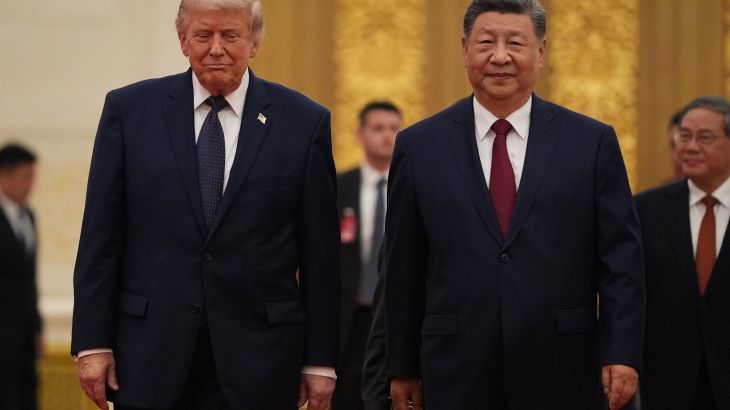
Those tensions were visible during Trump’s China trip this month, when executives from major US chip and platform companies moved in the same diplomatic orbit as a White House threatening harder trade action. Washington wants a tougher line on chip dependence, yet it is still managing an industry whose biggest players sell into, source from or negotiate with Asia at almost every stage.
Greer put the point more plainly in Reuters:
“Having tariffs on semiconductors is really important. What’s even more important than having protection for facilities like this is making sure we do it on the right timing and in the right amount,”
Why timing matters
Government paperwork already sketches the strategy. A January Section 232 semiconductor proclamation in the Federal Register laid out a framework that included a 25 per cent ad valorem duty, a 90-day reporting window for USTR and Commerce, and carve-outs tied to chips destined for use inside the United States. That begins to answer the industry’s first question: how wide do exemptions need to be to keep domestic projects on schedule? Wide enough, at minimum, to avoid taxing the inputs and equipment those projects still need.

Industry executives make the same case for sequencing. Semiconductor supply chains are not linear, and even “domestic” production depends on imported tools, wafers, packaging steps and specialty components. The proclamation’s mix of duty language, exemptions and offsets reads less like a switch waiting to be flipped than a negotiating instrument that can threaten a tariff while preserving room for industry-specific timing.
The Micron example shows why that flexibility matters. The company has said it plans to invest US$200 billion in the United States, following a US$6.2 billion subsidy award under the CHIPS and Science Act. Those numbers make the political case for protection easier to tell. They also underline how much current US expansion still depends on predictability. If companies cannot tell which imported chips, tools or intermediate goods will be hit, they price the uncertainty into contracts before any tariff arrives.
Markets have already shown how little patience they have for long-dated factory promises. In a recent CNBC report on memory-chip stocks, Seagate’s chief executive said it would “take too long” to build new factories, a blunt reminder that supply chains cannot be reassembled at political speed. For buyers of chips, from data-center operators to device makers, the practical question is whether Washington can create more domestic capacity faster than it makes existing supply more expensive.
Greer also acknowledged the supply-chain tangle in direct terms:
“These are complex supply chains. We’ve seen offshoring of semiconductors for decades,”
The legal and pricing risk
Skeptics start one level higher, with the legal tool itself. Lawfare argued this month that the Trump administration is stretching Section 232 beyond its older national-security use into a broader instrument of economic policy. In the semiconductor case, that matters because the White House is not only trying to keep rival suppliers out. It is also trying to influence where companies fabricate, test and route chips before they reach customers.

Analysts and buyers land at the same concern. Tariffs do not have to land neatly on a finished chip to matter. McKinsey says duties can bite at several points in the chain, from components to downstream electronics, and the Federal Reserve’s tariff research suggests companies often pass those costs through over time rather than immediately. For buyers of servers, networking gear and consumer devices, the likeliest outcome is not a single dramatic price jump on day one. It is a slower repricing that surfaces in procurement budgets, contract renewals and eventually retail shelves.
Lawfare’s warning also turns on discretion. A tariff regime built on security reviews, exemptions and presidential timing gives Washington flexibility, but it gives companies less certainty than a stable tax or subsidy program would. That may suit an administration that wants more room to pressure China and sway multinationals deciding where to expand. It is less comfortable for firms planning multibillion-dollar fabs on investment cycles that last years, not news cycles.
Recent history cuts both ways. The White House can point to the geopolitical case for moving faster: Trump’s trade push with China again exposed how deeply chip policy sits inside a wider bargaining relationship with Beijing. Yet the same period has shown how hard disentanglement remains. Days after that summit, AMD chief Lisa Su met China’s vice premier and pledged deeper investment, a reminder that companies are still building around Asian manufacturing ecosystems they cannot replace quickly.
Used that way, the tariff threat may prove more useful as pressure than as a blunt revenue tool. A hard levy with narrow exemptions could raise the cost of servers, phones and industrial equipment before it meaningfully changes where advanced chips are made. A phased regime with broad carve-outs, by contrast, would function more like industrial signaling, warning companies that future capacity belongs in the United States if they want to stay ahead of the next round of trade friction.
For now, the administration is trying to hold three positions at once: the political language of protection, the strategic logic of decoupling and the economic benefits of uninterrupted chip investment. The next 90 days will show whether those positions can be written into an actual tariff regime. If they cannot, Washington risks taxing a supply chain it still needs before it has rebuilt one of its own.

Kai Mendel
Technology editor covering fintech, AI and the platform economy. Reports from San Francisco.