Norway opens talks to join France's nuclear umbrella
Norway and France said they will open talks on extending French nuclear deterrence to Oslo, a step both leaders said would complement NATO.
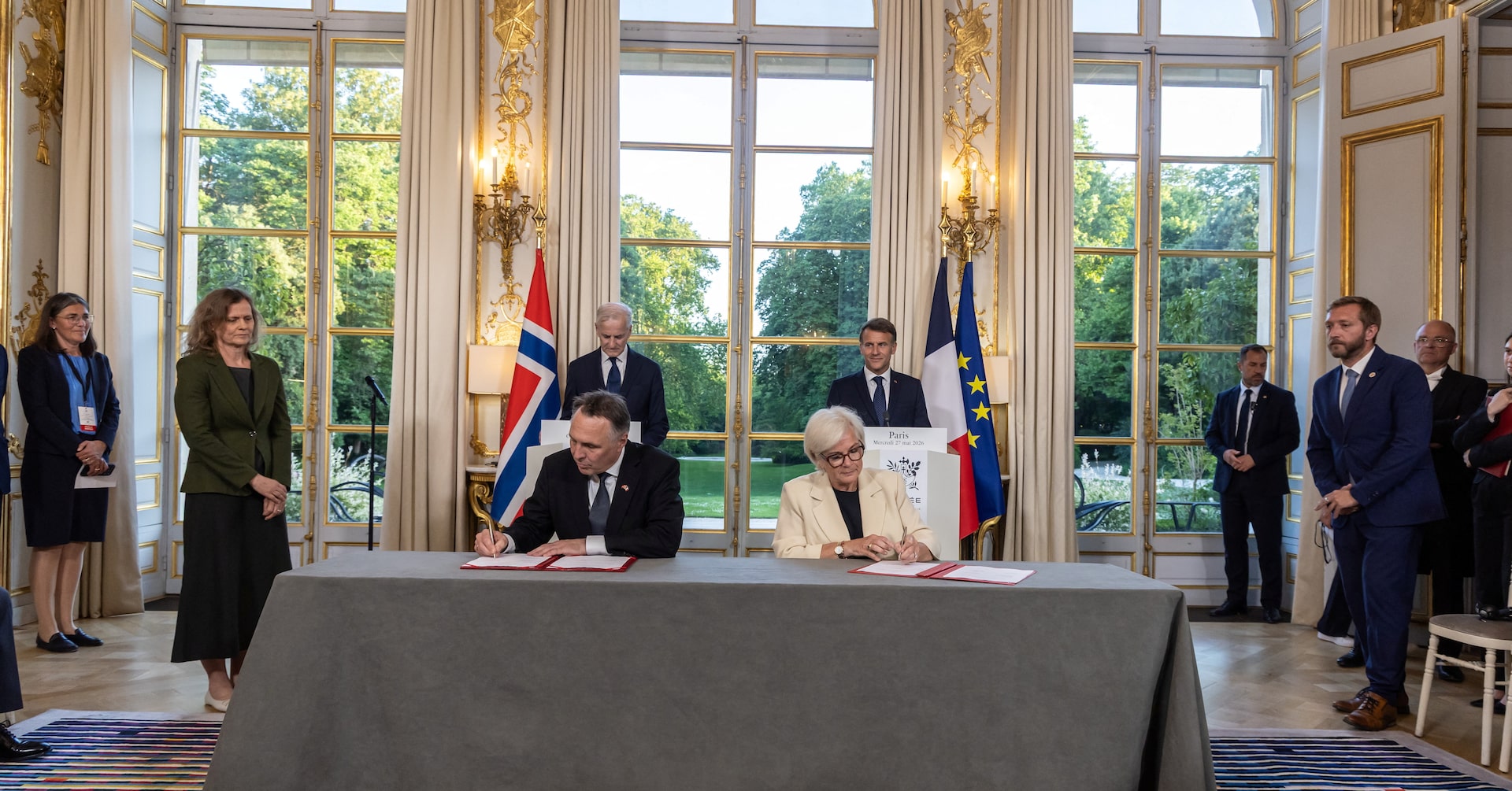
Norway will open talks to come under France’s nuclear umbrella, Prime Minister Jonas Gahr Stoere and President Emmanuel Macron said on Tuesday, in a move that gives Oslo a direct stake in a European deterrence debate that has sharpened as allies question how far US security guarantees can be taken for granted.
Both leaders framed the step as a supplement to NATO, not a break from it. They did not describe any immediate basing change or any Norwegian move to acquire nuclear weapons, but the announcement brings a NATO ally on Russia’s northern flank closer to the only nuclear arsenal in the European Union.
Stoere said the move would strengthen alliance deterrence. In comments reported by Reuters, he said France’s strategic forces broadened NATO’s posture at a time when European governments want more than one pillar supporting their security planning.
“France’s capabilities are an important contribution to NATO’s deterrence posture, which is important for us,” Stoere said, according to Reuters.
Macron said the accord would rest on mutual assistance between Paris and Oslo. That fits a long-running French argument that Europe should carry more of its own deterrence burden as the war in Ukraine and Donald Trump’s return to the White House raise new doubts about how automatic future US cover would be.
“This agreement establishes a principle of mutual assistance between our two countries,” Macron said, according to Reuters.
If the talks conclude, Norway would become the ninth country in the French deterrence scheme, after eight others, France 24 reported. The broadcaster also said France’s arsenal at about 290 warheads underpins any extended pledge. For Norway, that matters less as a numerical comparison than as evidence that a European ally is willing to discuss nuclear backing in explicit political terms.
For Oslo, a country of 5.6 million people, the decision widens its deterrence options without changing its NATO membership. For Paris, it gives Macron a visible example of a European defense role attracting support beyond the usual autonomy debate in Brussels. Both governments described the step as compatible with NATO, but the timing also reflects a reality now being voiced more openly across Europe: reliance on Washington is no longer discussed only behind closed doors.
The announcement also turned a broad argument about European strategic autonomy into a bilateral negotiation with named leaders and a public political commitment. That shift, from institutional language to a state-to-state arrangement, is what gives the move weight.
What comes next
The statements left the military detail unresolved. Accounts cited by Reuters did not describe warhead movements, command changes or a timetable for implementation. Instead, the talks open a channel to define how consultations, crisis messaging and mutual-assistance language would work if the plan moves from principle to practice.
That next phase will matter in both capitals. Norway will need to show that closer alignment with France strengthens deterrence without blurring the line between NATO commitments and any bilateral guarantee. France will need to show that a wider umbrella can reassure partners while remaining under tight national control.
Other European governments will also watch the talks closely as they debate defense spending, force posture and how much strategic weight Europe can build on its own. A French-Norwegian framework would not redraw Europe’s nuclear map overnight, but it would show how quickly once-sensitive deterrence questions are moving into public policy.

Theo Larkin
Defense correspondent covering US military operations, weapons procurement and the Pentagon. Reports from Washington.