US ships $2.1bn in cheap APKWS rockets to Israel, Qatar and UAE as Iran war drains stockpiles
The State Department on May 1 cleared three emergency foreign military sales totalling $2.1 billion for the APKWS guided rocket, a Korean War-era weapon retrofitted as the West's cost-effective answer to Iranian Shahed drones. Israel and Qatar each get 10,000 rounds; the UAE gets 1,500 air-to-air guidance sections.
WASHINGTON, May 5 — The United States is rushing low-cost guided rockets to Israel, Qatar and the United Arab Emirates after the Iran war showed that the cheapest layer of air defence, not the most expensive, has become the most strategic.
The State Department on May 1 cleared three emergency foreign military sales totalling $2.1 billion for the Advanced Precision Kill Weapon System, or APKWS, a laser-guided rocket originally designed in the 1990s as an inexpensive ground-attack weapon and now repurposed as the West's most cost-effective answer to Iranian drones, according to notifications obtained by FlightGlobal and the Defense Post.
The notifications cleared 10,000 APKWS-II all-up rounds for both Israel and Qatar at a cost of $992.4 million each, and 1,500 APKWS-II guidance sections for the United Arab Emirates at $147.6 million, configured for the air-to-air variant of the weapon. BAE Systems is the prime contractor on all three packages. The State Department declared an emergency in each case, waiving the 30-day Congressional review period that the Arms Export Control Act would otherwise impose.
"This sale is intended to help Israel and Qatar address current and future threats and strengthen homeland defense," the State Department said in its notice for those two countries.
The rocket that became a drone killer
APKWS converts a standard, unguided 2.75-inch Hydra rocket into a laser-guided munition by bolting on a guidance section between the warhead and the motor. The base rocket itself dates to the Korean War. The kit is what is new, and what makes the system cheap. Each round costs in the low tens of thousands of dollars, an order of magnitude below interceptor missiles like the Patriot or NASAMS, which run into the millions per shot.
That asymmetry was the war's hardest economic lesson. Iran's Shahed-136 attack drone, the same model used in Russia's war in Ukraine, costs the regime an estimated $20,000 to $50,000 to manufacture. Shooting one down with a multi-million-dollar surface-to-air missile is, over time, a losing trade. APKWS, fired from helicopters, fixed-wing aircraft and increasingly from drones, closes that economic gap.
Why now
The Pentagon spent roughly $25 billion on the Iran war in its first weeks, the bulk of it on precision-guided munitions, according to FlightGlobal's analysis. That number drained US stockpiles to a degree that prompted the State Department this week to warn European allies, including the United Kingdom, Poland, Lithuania and Estonia, to expect long delays on undelivered US weapons orders, the Financial Times reported. The APKWS clearances are part of a broader $8.6 billion package, also approved on May 1, that includes $4 billion in Patriot replenishment for Qatar and $2.5 billion for Northrop Grumman's Integrated Battle Command System for Kuwait.
What the UAE order signals
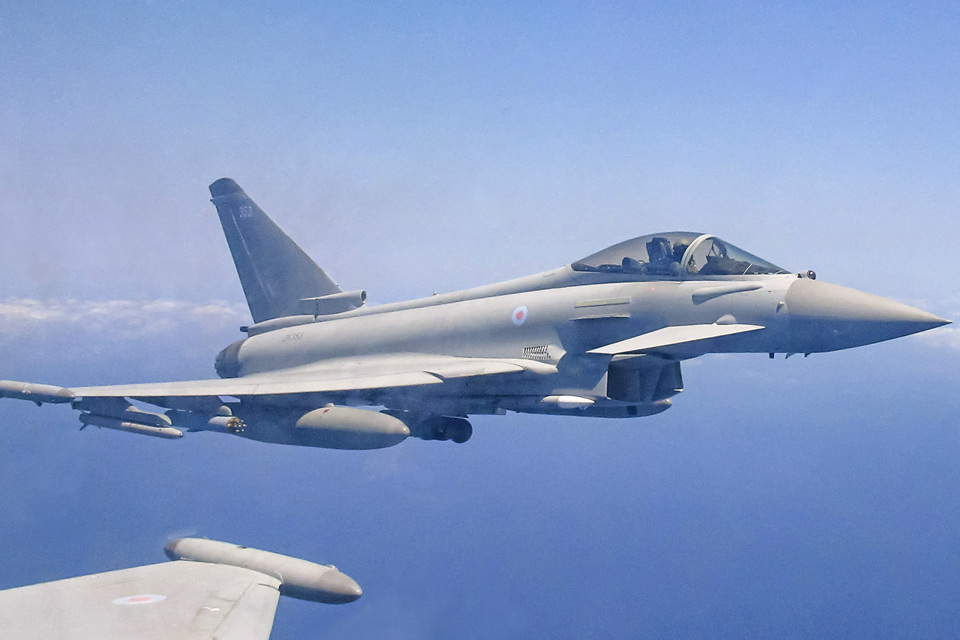
The UAE notification is the most striking of the three. The 1,500 guidance sections it ordered are configured for air-to-air use, meaning the Emirates plans to fire them from fighter aircraft against incoming drones rather than from the surface. That is one of the first formal acknowledgements that APKWS, designed for ground attack, is becoming a standard intercept weapon for cheap, slow aerial threats.
The shift matters because the UAE is the country that took the brunt of the latest Iranian salvo. On Monday it engaged 12 ballistic missiles, three cruise missiles and four drones from Iran, by its own count, and a separate strike on the Petroleum Industries Zone in Fujairah injured three Indian nationals. Adding APKWS to UAE fighter wings would push the cost-per-intercept down sharply for that very profile of attack.
Bypassing Congress
The emergency designation in all three cases is unusual but not unprecedented. The Arms Export Control Act allows the executive branch to skip the standard 30-day notification window when the State Department certifies that an emergency requires the proposed sale. The Trump administration has used the provision repeatedly during the Iran war to keep the supply chain to Israel and Gulf allies running on a wartime cadence.
A small group of senators on the Foreign Relations Committee, including some Republicans, have raised concerns about the pattern, but legislative action would now require congressional review of the sales after delivery rather than before, a much weaker check.
What comes next
The deals still need to be finalised in contract form, but BAE Systems has been ramping APKWS production for more than a year in anticipation of demand from US allies. The company opened a new line at its plant in Hudson, New Hampshire, last summer to add capacity, and the Pentagon has a separate domestic order for additional rounds to refill the US inventory drawn down during the war.
For Israel, Qatar and the United Arab Emirates the calculation is now straightforward: the cheaper Iran's offensive drones become, the cheaper the West's answer must be. The rocket that earned its first combat kill in the Korean War is, for now, that answer.

Theo Larkin
Defense correspondent covering US military operations, weapons procurement and the Pentagon. Reports from Washington.